


AI Tech
Sep 6, 2026
Can one 96GB Blackwell GPU serve a 27-billion-parameter model at more than 200 tokens per second? We deployed Qwen3.8-27B, tested four controlled configurations, and isolated the real impact of NVFP4, SGLang, vLLM, and DFlash2.


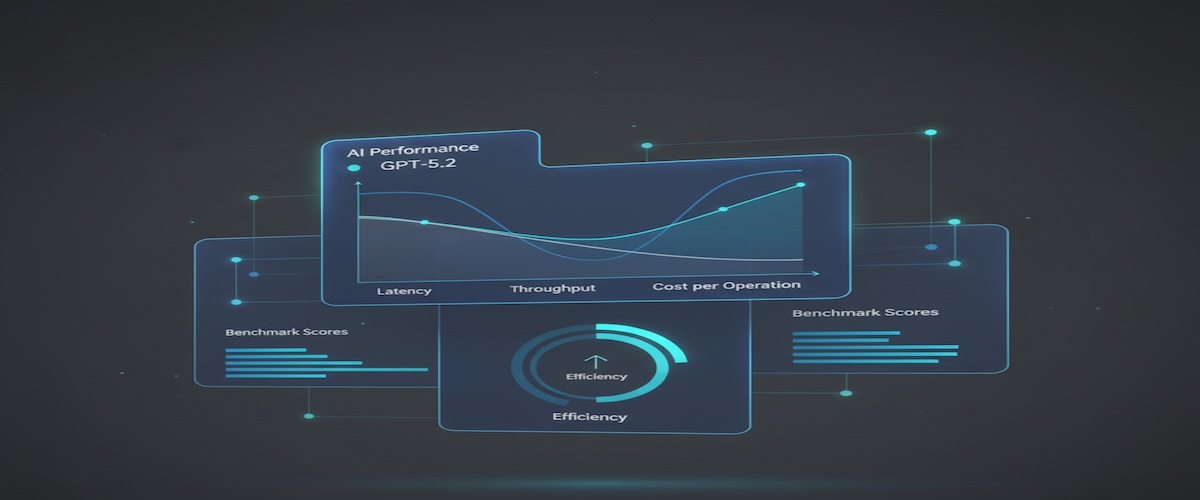
Estimated Reading Time: 12 minutes
It feels like we just finished unboxing GPT-5.1. Yet, here we are again.
In early December 2025, OpenAI hit the "Red Code" button. They released GPT-5.2 precipitously, weeks ahead of schedule.
Why the rush?
The answer lies in the competition. Users were quietly migrating away from ChatGPT. They were finding a new home with Google's Gemini 3 Pro for its visual magic and Anthropic's Claude 4.5 Opus for its elegant coding. OpenAI had to stop the bleeding.
They needed to put their foot down. And they did it with a model that promises overwhelmingly high numbers.
But if you are a developer, a business owner, or just a power user, you need to look past the hype.
On paper, OpenAI's new model 2025 is a beast. It crushes math tests and solves physics simulations that baffled previous AIs. However, there is a nuance hidden in the fine print—specifically regarding its "Thinking" capabilities and the new price tag attached to them.
Is this the new king of AI, or is it just a slightly smarter model hidden behind a paywall?
Let's break down the data, the real-world tests, and the costs to see if GPT-5.2 is worth your money.
When OpenAI dropped the blog post for this model, the numbers looked impossible.
We aren't talking about small 2% or 3% improvements anymore. We are seeing jumps that represent entirely new classes of intelligence.
If you care about raw intelligence, two benchmarks stand out above the rest.
1. The ARC-AGI 2 Score
This is the big one. The ARC-AGI benchmark doesn't test memory; it tests the ability to learn new things on the fly. It is widely considered the closest test we have to measuring "true" intelligence.
That is a massive leap. It suggests that GPT-5.2 isn't just reciting data it learned during training; it is adapting to new puzzles it has never seen before.
(Source: OpenAI's official announcement)
2. Math & Science Dominance
For the scientists and engineers, the results are equally stark.
On paper, it beats Gemini 3 Pro (which scored ~95% on AIME) and Claude 4.5 Opus (at ~94%).
(Source: Benchmark comparison on X)
Here is where you need to be careful.
The numbers above are impressive. But there is a catch that bothers many analysts.
To achieve these record-breaking scores, OpenAI ran the GPT-5.2 benchmarks using the "Extra-High" (xhigh) reasoning effort. This is a mode where the AI takes a long time to "think" before it answers, running through thousands of possibilities to find the right one.
Why does this matter?
Because you probably can't use it.
OpenAI is effectively gate-keeping the top-tier intelligence. When you see a chart comparing GPT-5.2 to Claude or Gemini, remember that the OpenAI bar represents a $200 experience, while the competitors are often showing you what you get for $20.
Benchmarks tell us one story. Using the tools for real work tells us another.
We analyzed hours of testing across coding, vision, and logic tasks to see which model actually helps you get work done.
Here is the AI model comparison breakdown.
If you use AI to write software, the choice between these three giants is becoming very clear.
The Good: GPT-5.2 is a Physics Engine
In one test, the model was asked to code an "Ocean Wave Simulation" in a single HTML file.
It didn't just write code; it understood physics.
It created a 3D environment with adjustable wind speed, wave height, and lighting.
It worked on the first try.
This shows that GPT-5.2 coding capabilities are incredibly strong when it comes to logic, math, and complex systems. It builds things that work.
The Bad: It Has No Taste
In a different test, the models were asked to build a "Garmin Dashboard" to visualize health data.
The Verdict: If you need a backend engineer to make sure the math works, use GPT-5.2. If you need a frontend developer to make it look professional, stick with Claude 4.5 Opus.
Visual reasoning isn't just about describing a picture. It's about understanding what is happening in that picture.
The "Where's Waldo" Test
In a test involving an image of cheese with a hidden message ("I know it's hard to read"), the difference in approach was hilarious.
The Technical Diagram Test
However, when shown a complex motherboard and asked to identify the chips:
GPT-5.2 excelled. It drew accurate bounding boxes around specific ports, RAM slots, and chips that previous models missed.
It applied logic to what it was seeing, rather than just guessing.
The Verdict: Gemini 3 Pro remains the King of Multimodality for creative or quick visual tasks. But GPT-5.2 Thinking mode wins when you need to analyze technical diagrams or charts where precision matters more than speed.
OpenAI is pushing a clear message with this release. They want you to stop chatting with their AI and start putting it to work. The focus has shifted entirely to "economically valuable tasks"—jobs that businesses actually pay humans to do.
This isn't about writing poems or jokes anymore. It's about accuracy, reliability, and autonomy.
For years, large language models have been terrible at math. They could write a sonnet about a spreadsheet, but they couldn't calculate the sum of column B.
In critical financial tests, such as managing complex cap tables, earlier models like GPT-5.1 failed dangerously. They would hallucinate liquidation preferences, leading to incorrect payout calculations. In the real world, that kind of error costs millions.
GPT-5.2 handles these tasks with a new level of precision. It doesn't just guess; it reasons through the financial logic step-by-step. This makes it a viable tool for analysts who need to trust the output without double-checking every single cell.
Another area where this model excels is structured reporting.
Imagine dumping a messy folder of project data, emails, and timelines into an AI and asking for a clean Gantt chart.
It can digest raw, unstructured information and format it into professional project management documents. This capability allows managers to turn hours of data entry into minutes of review.
Perhaps the most fascinating shift is the move toward "agentic" behavior.
Previous models were like impatient interns. If they didn't know the answer immediately, they would make one up. GPT-5.2 is different. It acts more like a diligent researcher.
It is willing to spend time solving a problem.
In one test, it spent nearly 50 minutes "thinking" and researching to generate a PowerPoint presentation.
It browsed the web, read academic papers (like ICLR and NeurIPS), extracted charts, and synthesized the findings.
While the final design of the slides was still a bit rough, the proactive effort was undeniable. It didn't just write text; it tried to do the job of a human analyst.
Finally, OpenAI has made significant strides in safety.
One of the biggest barriers to enterprise adoption is hallucination—when the AI confidently lies. GPT-5.2 has reduced hallucination rates to 6.2%, down from 8.8% in the previous version.
Furthermore, internal system cards show strong improvements in mental health safety metrics. The model is better at handling sensitive topics without being overly restrictive or unhelpful.
All this new power comes with a price tag. And for the first time in a long while, that price is going up.
If you are using the API to build apps, you need to update your budget spreadsheets.
This represents a roughly 40% price increase compared to GPT-5. That is a significant hike for developers running high-volume applications.
However, the raw price per token doesn't tell the whole story.
While the cost per token is higher, the cost to solve a problem has actually plummeted.
Consider the ARC-AGI benchmark we discussed earlier. A year ago, achieving a high score on these reasoning tasks using experimental models (like o3-high) cost about $4,500 per task.
Today, GPT-5.2 can achieve a better score for just $11.64 per task.
That is a 390x improvement in cost efficiency for high-level reasoning.
So, is the price justified?
The answer depends entirely on what you are doing.
YES: If you are solving "frontier" problems—complex math, deep coding, scientific research, or financial analysis. The ability to get expert-level reasoning for $11 is a bargain compared to hiring a human consultant.
NO: If you are just using it as a chatbot for simple queries, emails, or summaries. For these tasks, the cheaper models (or even the free tier) are more than enough.
GPT-5.2 marks a turning point. It is no longer just a fun toy for writing poems or generating funny images. It has evolved into a serious, industrial-grade tool for professionals.
It is a technical marvel that pushes the boundaries of what AI can do in math, science, and coding. But it also creates a divide. The best features are locked behind a high paywall, leaving casual users with a "lite" version of the experience.
If you are trying to decide which model to subscribe to, here is the cheat sheet:
OpenAI hasn't hit a wall. Pre-training is still delivering massive gains.
But the gap between the "Pro" users and the "Standard" users is widening. If you want to see the future of intelligence, you're going to have to pay for it.
Q: Is GPT-5.2 better than Claude 4.5 Opus for coding?
A: It depends on the type of coding. For backend logic, physics simulations, and complex algorithms, GPT-5.2 is superior. However, for frontend web development, UI/UX design, and generating clean, stylish dashboards, Claude 4.5 Opus is still the winner.
Q: Can I access the full reasoning power of GPT-5.2 with ChatGPT Plus?
A: No. The standard $20/month ChatGPT Plus plan gives you access to "Extended" reasoning (Medium effort). To access the "Extra-High" (xhigh) reasoning that achieved the top benchmark scores, you need the $200/month Pro subscription.
Q: What is the biggest improvement in GPT-5.2?
A: The biggest leap is in adaptive reasoning. The jump in the ARC-AGI 2 score from 17% to 52.9% shows that the model is much better at learning new tasks on the fly, rather than just repeating memorized patterns.
Q: Why is GPT-5.2 more expensive?
A: OpenAI has increased the API pricing by roughly 40% to account for the increased computing power required by the model. However, for complex reasoning tasks, the model is actually far more efficient than previous experimental models.
Q: Is GPT-5.2 safe to use for business data?
A: Yes, reliability has improved. Hallucination rates have dropped to 6.2%, and the model performs significantly better on "economically valuable tasks" like financial analysis and reporting, making it a safer bet for enterprise use.
Can one 96GB Blackwell GPU serve a 27-billion-parameter model at more than 200 tokens per second? We deployed Qwen3.8-27B, tested four controlled configurations, and isolated the real impact of NVFP4, SGLang, vLLM, and DFlash2.
A deep dive into building a white-label SaaS health platform with AI-powered lab analysis, tiered model routing, and per-clinic customization — from architecture decisions to production deployment.

NexGen Compute provides HPC consulting, deployment, and remote management for high-end GPU workstations, servers, and AI clusters. With 10+ years of hands-on experience, we help businesses choose hardware, resolve multi-GPU issues, and optimize AI workloads.
info@nexgen-compute.comCopyright © NexGen Compute | 2026


