

AI Tech
Sep 6, 2026
Can one 96GB Blackwell GPU serve a 27-billion-parameter model at more than 200 tokens per second? We deployed Qwen3.8-27B, tested four controlled configurations, and isolated the real impact of NVFP4, SGLang, vLLM, and DFlash2.


Discover how Gemini 3.0 Flash delivers near-Pro intelligence at a fraction of the cost, beating benchmarks like ARC-AGI and transforming fast, cheap AI models.

SEO Content Writer



Estimated reading time: 15 minutes
Gemini 3.0 Flash was never supposed to be exciting.
By design, Flash models sit on the practical side of the spectrum: faster, cheaper, and clearly less capable than the flagship Pro version. They exist to save money, not to impress.
That expectation is exactly why Gemini 3.0 Flash matters.
Because this time, the usual trade-off broke. Gemini 3.0 Flash delivers near-Pro-level intelligence while remaining dramatically faster and cheaper. In some benchmarks, it even edges ahead of Gemini 3 Pro.
This is not a marginal upgrade. It signals a deeper shift in how modern AI models are trained, evaluated, and deployed at scale.
If you care about real-world AI usage—coding, agents, production systems—Gemini 3.0 Flash is not "the smaller model." It is the model that forces a rethink.
Benchmarks are often treated like scoreboards.
In reality, they are stress tests. Each one pushes models in a different way, revealing strengths and failure modes that don't show up in demos.
Google Gemini 3 benchmarks span several categories:
The value is not any single number. The value is the pattern across benchmarks.
Gemini 3.0 Flash shows consistency across very different tests, which is why the results are hard to dismiss as noise.
Humanity's Last Exam is designed to probe broad reasoning ability.
It mixes logic, knowledge, and adaptation under tight constraints. Models that score well here tend to handle unfamiliar problems without collapsing.
This benchmark has become a reference point for frontier-level reasoning discussions.
Gemini 3.0 Flash narrowing the gap here is a strong signal that it's not just optimized for speed.
GPQA Diamond focuses on graduate-level science questions.
These tasks require:
Performance here matters for research, medicine, engineering, and technical analysis.
Flash staying within a few points of Pro suggests genuine reasoning capability, not surface-level pattern matching.
SWE-bench Verified is where many models struggle.
It tests real software engineering tasks on real repositories. The model must:
This benchmark aligns closely with how developers actually use AI today.
Strong results here mean the model can participate in production workflows, not just generate examples.
For years, AI followed a simple rule:
This wasn't a design choice. It was a compute reality.
Flash models lived firmly on the "speed" side of the trade-off. Expectations were modest:
Gemini 3.0 Flash breaks this pattern.
Instead of behaving like a "lite" model, it behaves like a compact frontier model.
That is why its benchmark performance matters more than usual.
Gemini 3 Flash performance stands out because it is broad, not narrow.
The model doesn't shine in one cherry-picked test. It performs competitively across reasoning, coding, and agentic evaluations.
The deeper insight is this:
The cost-intelligence curve has bent sharply downward.
That bend changes which models make sense in real systems.
In practice, teams don't chase maximum intelligence. They optimize for:
If one model is slightly smarter but much slower and more expensive, it usually loses.
Gemini 3.0 Flash hits a rare balance point:
That combination is more valuable than peak benchmark scores.
The most interesting question is also the most uncomfortable one:
How can a Flash model rival the Pro model it was distilled from?
Gemini 3 vs Gemini 3 Pro comparisons reveal something subtle:
This reverses the usual hierarchy.
Instead of Flash lagging behind, Flash sometimes benefits from later-stage optimizations that Pro hasn't yet incorporated.
Understanding why requires looking at how these models are trained.
The transcript points to reinforcement learning as the key driver.
Reinforcement learning in language models moves beyond static text prediction. Instead of only learning what sounds right, the model learns what works over sequences of actions.
This matters for tasks that involve:
A DeepMind engineer explained that Gemini 3.0 Flash benefited from advances in agentic reinforcement learning that arrived after Pro was finalized.
Agentic tasks are not single-turn questions. They are loops:
Older fast models tend to rush ahead and fail. Agentic RL training systems reward long-term success, not short-term correctness.
This helps explain why Flash appears unusually capable for its size. It has learned how to navigate tasks, not just answer prompts.
Speed used to be a convenience.
Today, it is infrastructure.
As AI becomes embedded in:
Latency compounds. Every extra second slows iteration and breaks focus.
Fast and cheap AI models enable:
A model that responds in five seconds instead of fifteen doesn't just feel faster. It changes how people use it.
That is why Gemini 3.0 Flash matters strategically. It makes high-quality reasoning routine, not rare.
ARC-AGI has never been about comfort.
It exists to answer a single, brutal question: Can an AI solve problems when no rules are given and no shortcuts exist?
That makes it very different from most benchmarks.
ARC-AGI tasks require:
For years, progress here was slow and expensive.
Gemini 3.0 Flash changes that dynamic.
The most important ARC-AGI metric is not accuracy.
It is cost per solved task.
Until recently, strong ARC-AGI results came with extreme prices:
That made ARC-AGI impressive—but irrelevant for real systems.
Then the curve broke.
Recent analysis shows that models released in late 2025 collapsed this cost curve by orders of magnitude. Gemini 3.0 Flash sits at the extreme end of this shift, achieving near-human success rates at well under one dollar per task.
This is not a tuning win. It is an economic transition.
When reasoning costs cents instead of thousands, it becomes deployable.
ARC-AGI 1 is being saturated.
That is not a failure. It is a success.
It means models have learned to generalize across its structure.
As a result, ARC introduced ARC-AGI 2, which raises difficulty in key ways:
These puzzles punish shallow pattern matching.
They reward real abstraction.
What matters here is not whether a single model "wins." What matters is the slope of improvement.
Gemini 3.0 Flash shows a steep slope relative to its size and cost, which places it among the most efficient ARC-AGI 2 performers to date.
Efficiency is the new metric that matters.
ARC-AGI 3 is a clean break.
It abandons static inputs and outputs.
Instead, it evaluates interaction over time.
Key properties:
This forces models to:
In other words, ARC-AGI 3 measures agentic intelligence.
This aligns directly with where AI systems are heading: not answers, but actions.
ARC-AGI 3 will define the frontier for 2026.
Agentic AI models live or die by feedback loops.
They must:
Fast feedback is critical.
Slow models stall. Cheap models explore.
Gemini 3.0 Flash is unusually well positioned here because it combines:
This is not accidental.
Research into agentic reinforcement learning shows that feedback-driven training dramatically improves stability across multi-step tasks—even in compact models.
That training shows up in practice:
This is exactly what agent-based systems need.
SWE-bench Verified is not abstract.
It tests whether an AI can function inside real codebases.
The model must:
Here, speed is not cosmetic.
Latency directly affects developer behavior.
Gemini 3.0 Flash performs competitively on SWE-bench Verified while delivering significantly faster iteration cycles than heavier models.
That speed compounds:
This is how fast and cheap AI models quietly outperform "smarter" ones.
Another factor behind Gemini 3.0 Flash is adaptive test-time compute.
Modern reasoning models no longer think at a fixed depth.
Instead, they:
This dynamic strategy allows smaller models to punch above their weight.
Research shows that test-time scaling can close large performance gaps without increasing base model size.
Gemini 3.0 Flash appears to use this approach effectively:
This preserves speed while protecting capability.
For enterprises, AI success is measured in systems, not demos.
Key constraints are:
Gemini 3.0 Flash directly addresses all four.
Google Cloud positions it as a production-ready model for:
This unlocks designs that were previously too expensive:
Cost no longer forces compromise.
Teams are converging on a clear workflow:
Why this works:
Flash excels at:
It acts as the system's engine, not its architect.
Two trends are now undeniable:
Gemini 3.0 Flash is not the end of this curve.
It is proof that the curve exists.
When the same agentic and test-time improvements reach future Pro releases, the ceiling will rise again.
But the floor has already dropped.
Near-frontier intelligence is no longer rare.
It is becoming standard infrastructure.
Gemini 3.0 Flash is not impressive because it is fast.
It is impressive because it makes advanced reasoning cheap enough to use everywhere.
By combining:
Google has collapsed a trade-off that defined AI for years.
ARC-AGI shows the economic shift. SWE-bench Verified shows real-world strength. Enterprise tooling shows readiness.
Gemini 3.0 Flash is not the backup model.
It is the new baseline.
Gemini 3.0 Flash is a fast, low-cost AI model from Google designed for production use. It delivers strong reasoning, coding, and agentic performance at much lower latency and cost.
Gemini 3.0 Flash is significantly faster and cheaper, with only small performance gaps on most benchmarks. In some agentic and coding tasks, it performs on par with Pro.
It benefits from agentic reinforcement learning, adaptive test-time compute, and newer training improvements that optimize multi-step reasoning.
ARC-AGI measures adaptive problem-solving on unseen tasks. Strong performance at low cost signals real progress toward general reasoning.
Yes. It is positioned for scalable, low-latency deployments and cost-controlled AI agents.
For execution, iteration, and agent workflows, yes. For deep planning and architecture, larger models may still help.
No. ARC-AGI benchmarks test reasoning stress points, not AGI itself. Flash shows progress, not completion.
Future Pro models are expected to absorb these improvements, pushing both intelligence and efficiency further.
Bottom line: Gemini 3.0 Flash marks the moment when powerful reasoning stopped being expensive.
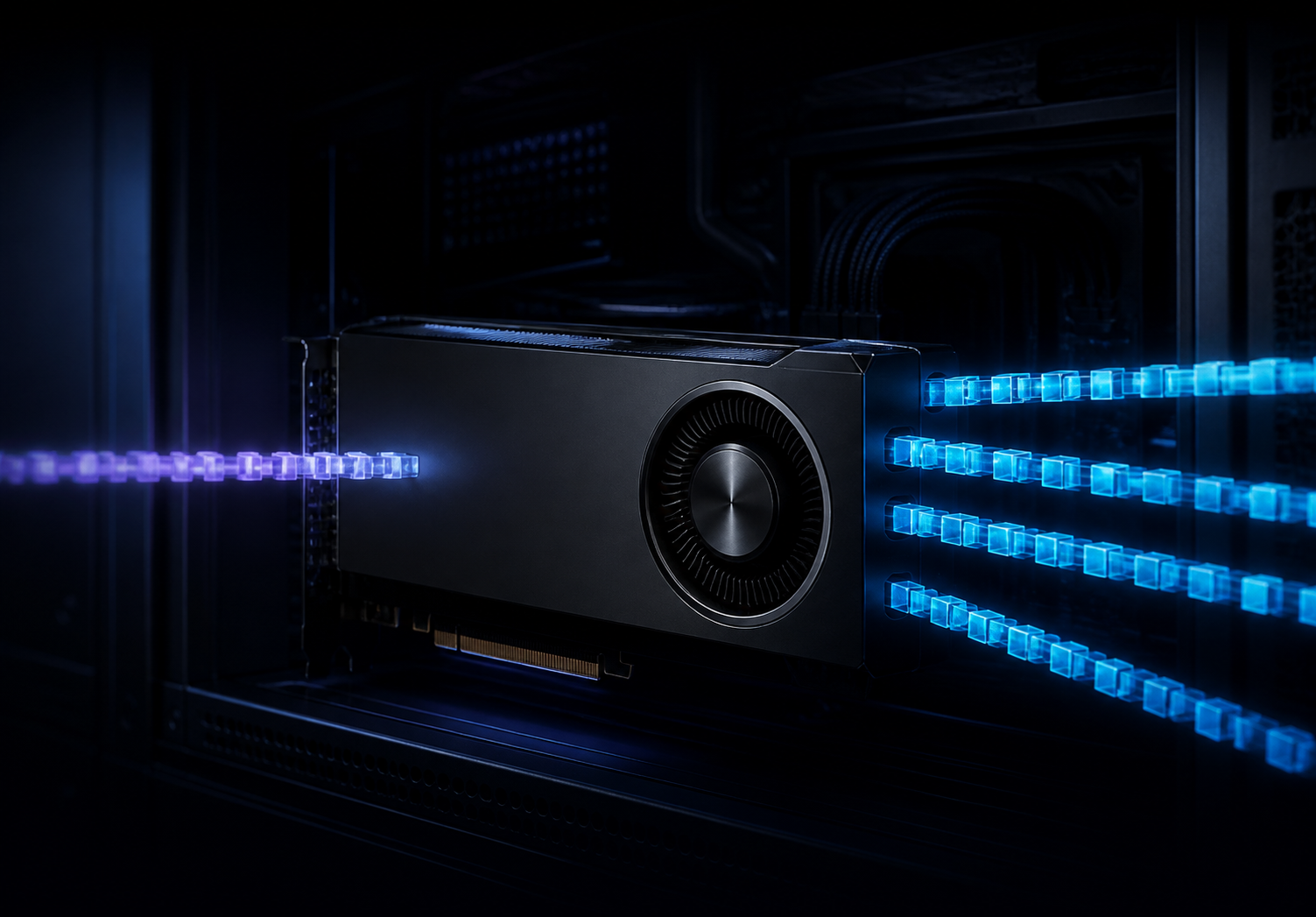
Can one 96GB Blackwell GPU serve a 27-billion-parameter model at more than 200 tokens per second? We deployed Qwen3.8-27B, tested four controlled configurations, and isolated the real impact of NVFP4, SGLang, vLLM, and DFlash2.
A deep dive into building a white-label SaaS health platform with AI-powered lab analysis, tiered model routing, and per-clinic customization — from architecture decisions to production deployment.

NexGen Compute provides HPC consulting, deployment, and remote management for high-end GPU workstations, servers, and AI clusters. With 10+ years of hands-on experience, we help businesses choose hardware, resolve multi-GPU issues, and optimize AI workloads.
info@nexgen-compute.comCopyright © NexGen Compute | 2026


